Strategy
See the bigger picture.
Make the right move.

We often feel as though we fully understand the business path we’ve taken or the one we’re about to take.We start from the belief that the company exists entirely in the mind of its leader. I can tell you with absolute certainty that that is the exact moment when you’ll start losing value. Whether it’s the first step for a startup or the next step for an established company, decisions can rarely be made based on a single piece of data without weighing all the factors—even if you have the best idea in the world and even if you’re certain you know all the secrets of an industry. My role is to help companies take a step back and take a 360-degree look at the scenario they’re about to face. That’s why I’ve always believed that an advisory firm’s job isn’t simply to create a business plan for the bank or other parties, but first and foremost to develop a corporate strategy. If I were to limit myself to presenting a business plan that meets financial and capital requirements but didn’t tell you how to best allocate your resources—or what would happen in the event of positive or negative changes—I wouldn’t be helping you at all; in fact, I’d only be complicating matters. Ultimately, the analyst’s task is to create a plan—whether for a product launch, a turnaround, raising capital, or something else. A plan that always supports the company, serving as its compass in the sea of business.Translated with DeepL.com (free version)
Questions we help answer.

I have a business idea. How can I turn it into a solid business plan?
The first step is to assess its economic and market viability. From there, we identify the key factors across every aspect of the business: from how value is created and delivered to customers to how they will be reached, from the revenue model and cost structure to the partners and resources required. We then bring everything together into a clear plan that shows how the idea can become a viable business.

We want to launch a new product. How can we assess whether it’s a viable opportunity?
The first step is to understand the need the product addresses and, consequently, the potential demand for it. This means analysing the market and distinguishing its overall size from the portion the company can realistically serve. We then assess how the new product fits within the company’s existing portfolio, what cost synergies it could create, and how it could impact future revenues.

We see an interesting market opportunity. How can we understand how big it really is?
We start by looking beyond the headline market size. By estimating the Total Addressable Market, Serviceable Available Market, and Serviceable Obtainable Market, we can distinguish the overall opportunity from the portion of the market the business can realistically serve and capture. The goal is not to eliminate uncertainty, but to reduce it and build a stronger analytical foundation for the decisions that follow.

Our business is growing. How can we build a clear plan for the next stage?
Managing growth effectively is one of the most complex challenges a business can face. As a company grows, profitability can quickly come under pressure as costs, resources, and different areas of the business become harder to control. That’s why growth needs to be structured before accelerating, with clear priorities, the right resources, and a solid understanding of its financial sustainability.

We need to rethink our direction. What should we focus on first?
The first step is to define where the business wants to be in the long term. Only once that destination is clear can we build a coherent strategy: the best path to get there, taking into account the company’s resources and constraints.
Know what it’s worth, Understand why.
Valuation

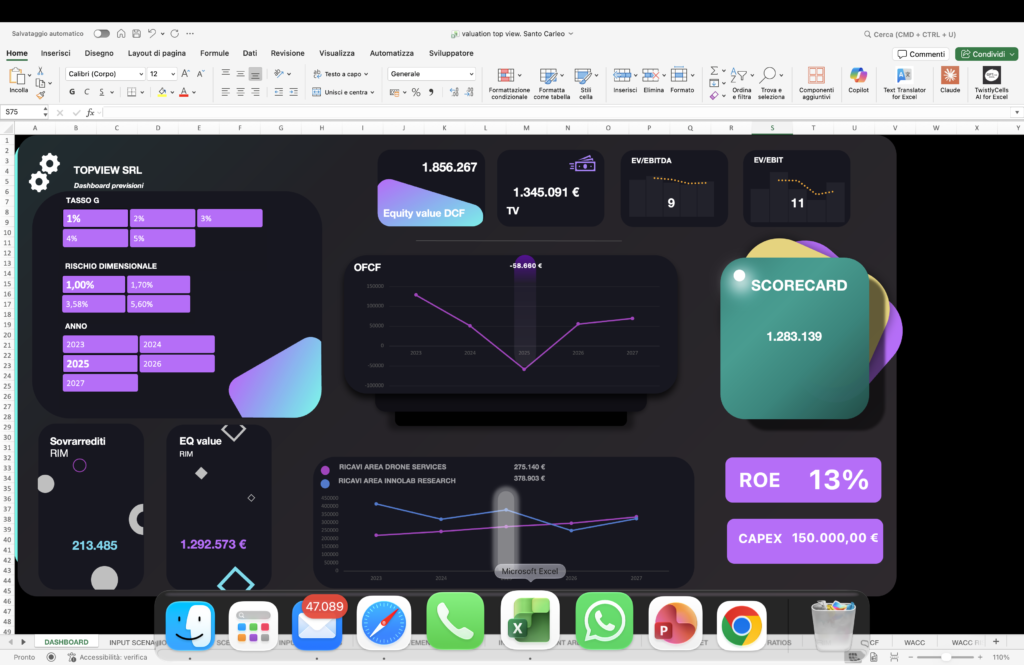
Valuation models. Building a valuation model is a complex process. It means breaking a business down into its smallest components, understanding each one, and bringing them back together into a coherent financial model. The goal is not simply to build the model itself, but to understand the business behind it — its economics, assumptions and value drivers — in order to arrive at a well-founded valuation range.
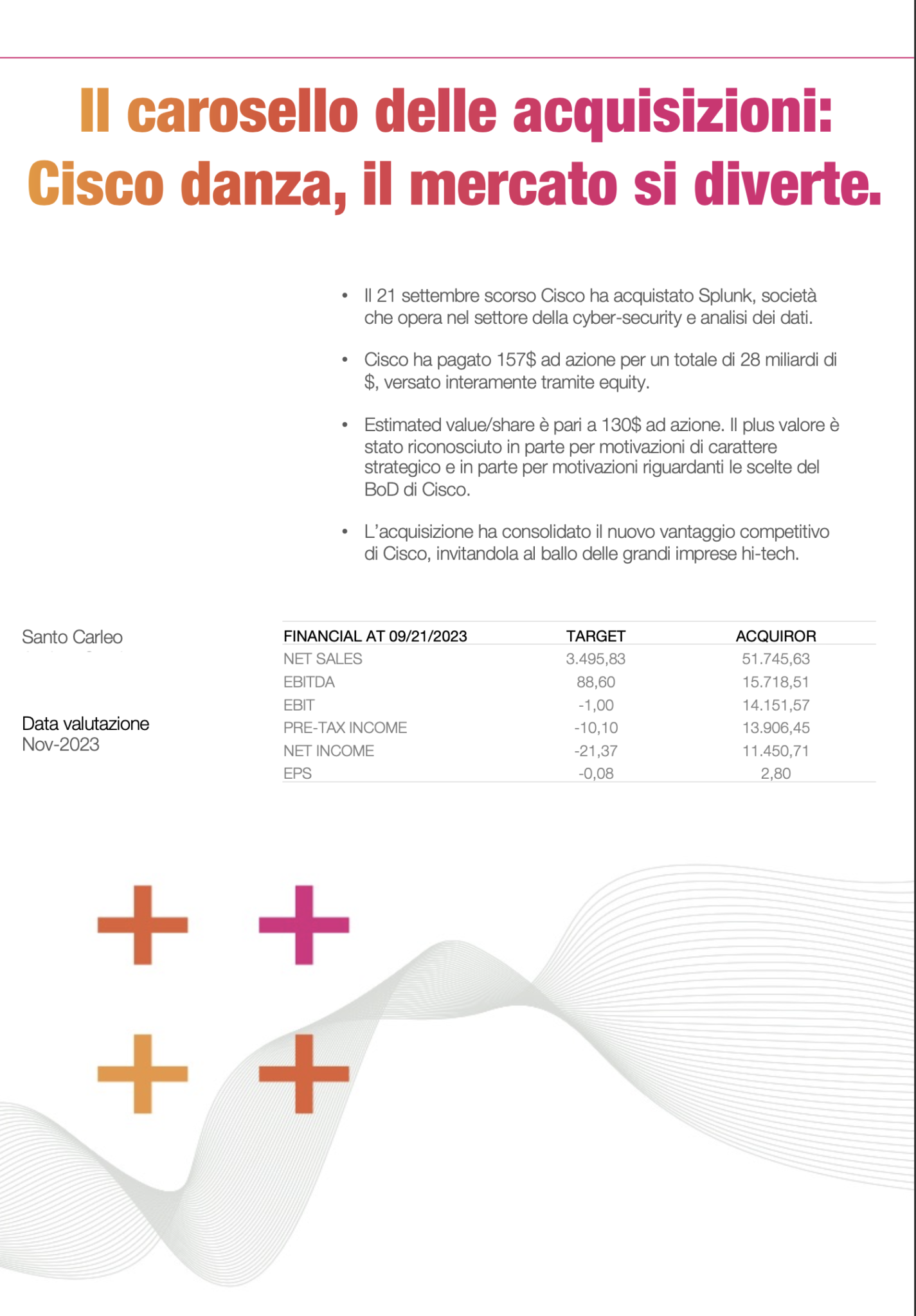
Deal & Transaction Analysis. M&A transactions can easily lead to overvaluation when expected synergies, growth opportunities and goodwill are assessed too optimistically. A rigorous transaction analysis helps distinguish strategic potential from the price actually worth paying, testing the assumptions behind the deal before they become expensive mistakes.
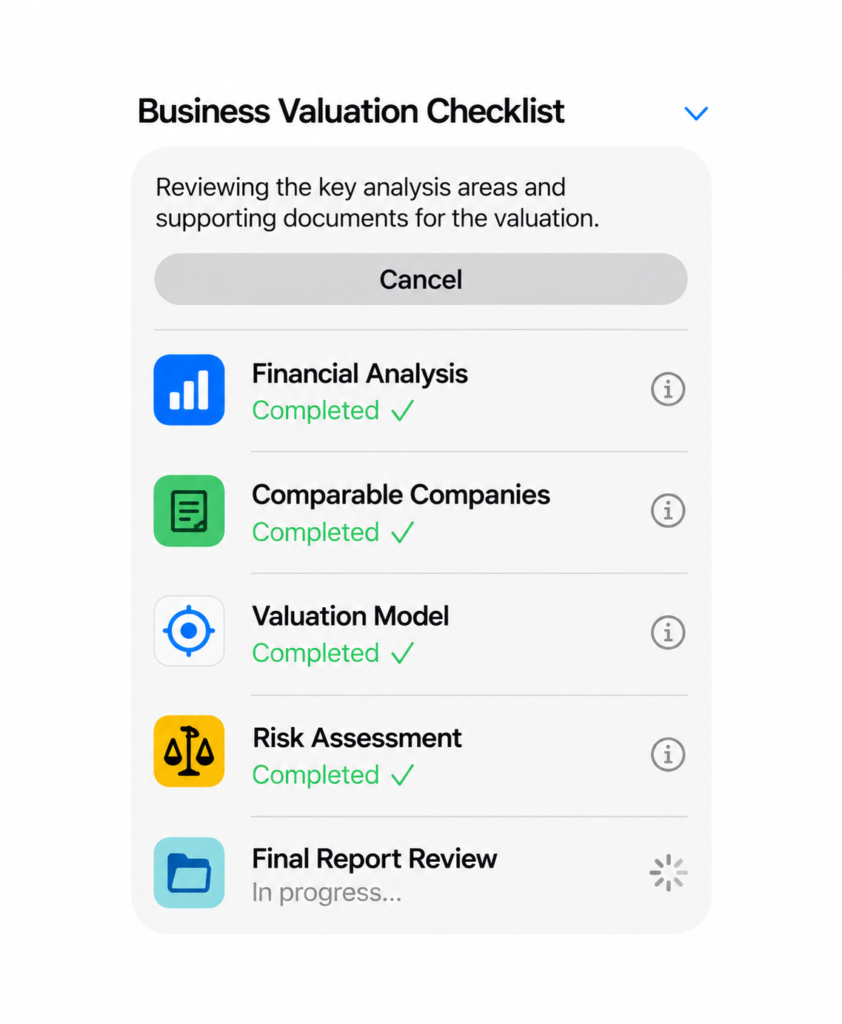
Roadmap. Every analyst has their own approach to navigating a valuation. Mine is built as closely as possible around the intrinsic characteristics of each business I analyse. Rather than forcing every company into the same framework, the process adapts to how that specific business operates, creates value and generates cash flows.
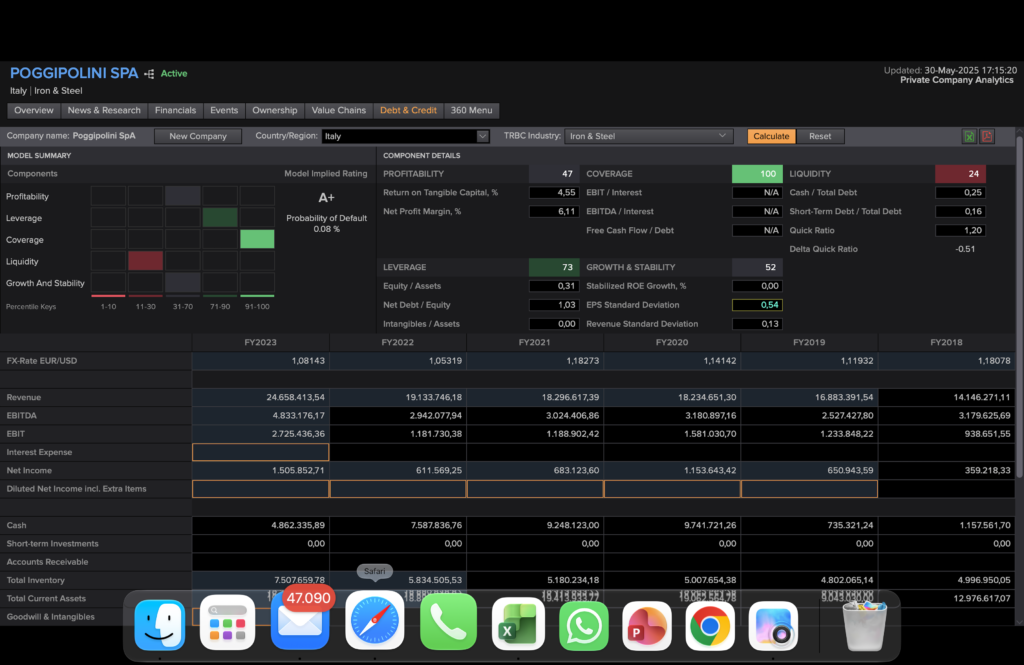
Value Creation Analysis. An analyst should not only estimate a valuation range that comes as close as possible to the intrinsic value of a business, but, more importantly, understand where that value comes from. Identifying the factors that create, sustain or erode value is what turns a good valuation into a great one.

The Story Behind the Number. A valuation is not just a number. It should tell the story of how that number was reached — the assumptions behind it, the economics of the business and the factors driving its value. Only by understanding that story can we assess whether the final result truly reflects the intrinsic value of the business.
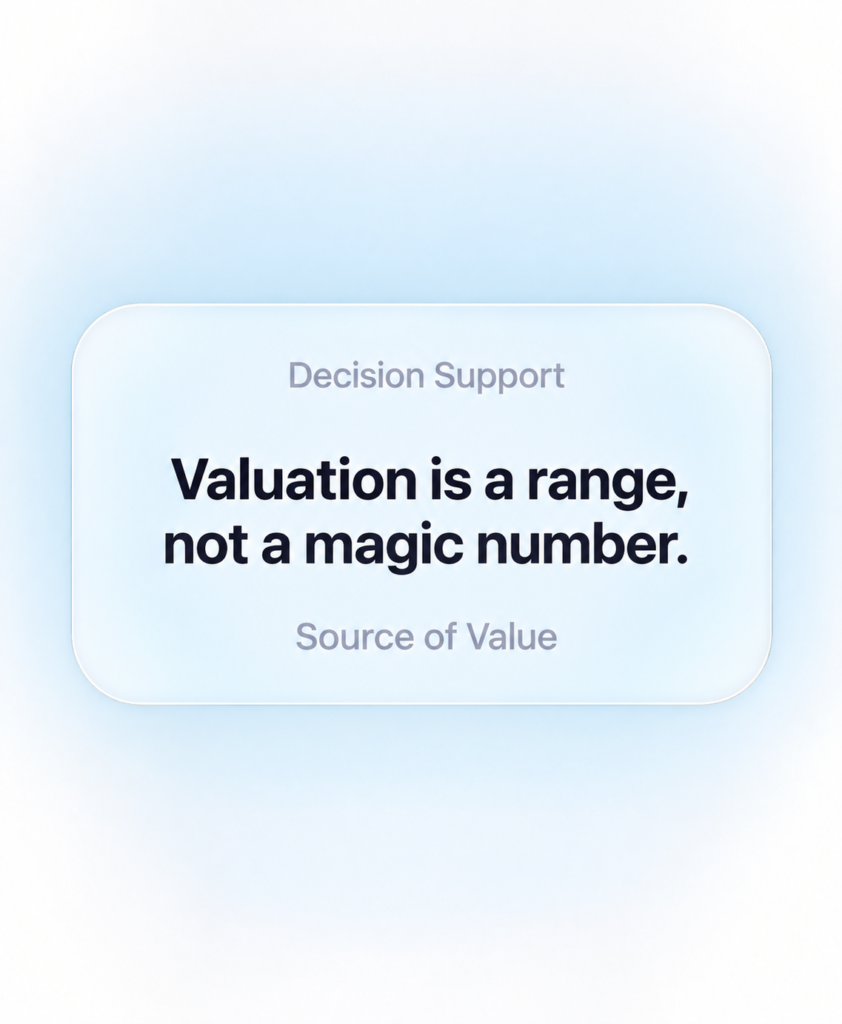
Valuation is a range. A valuation often results in a single figure, but the strongest valuations consider multiple scenarios. Different assumptions about growth, margins, risk or future performance can lead to different outcomes. Exploring these scenarios allows us to understand how value could evolve and define a valuation range that better reflects the business and its uncertainty.
Questions we help answer.

I’m considering selling my company. How can I determine its true value?
The value of any asset, including a business, is fundamentally linked to its ability to generate cash flows. Market perceptions may influence the price a buyer is willing to pay, but intrinsic value needs to rest on solid financial foundations. This is why we start with the company’s expected future cash flows, the risks associated with them and its financial position to determine a valuation range that reflects the economics of the business.

An investor wants to become a shareholder in the company. How can we determine a fair valuation?
Valuing an ownership stake is different from valuing the company as a whole, even though the two may initially appear similar. A stake may have characteristics that increase or reduce its value, such as control, voting rights, economic rights and other provisions attached to the investment. The analysis therefore starts with the intrinsic value of the business, while also considering the specific rights and characteristics of the stake being acquired.

A shareholder wants to exit the company. How can we determine the value of their stake?
Valuing an exiting shareholder’s stake can be particularly complex, as the circumstances of the transaction and the characteristics of the ownership interest can materially affect the result. The analysis should begin with the same principles used to value the entire business, while also considering factors such as control, the liquidity of the stake, its size and the specific terms governing the shareholder’s exit.

Is it possible to value a small business or a privately held company?
Yes. In fact, valuing privately held companies is often more complex than valuing listed businesses, as valuation models based on publicly traded companies are not always directly applicable. This is where the analyst’s judgement becomes particularly important: the model needs to be adapted to the specific characteristics of the business rather than forcing the company into a standard framework. Carleo Advisory focuses particularly on privately held businesses, using valuation approaches tailored to their economics, size and the information available.

My company isn’t profitable yet. Is it still possible to value it?
Yes, although the exercise becomes more challenging. Valuation uses financial analysis to reduce uncertainty, but when a company has limited historical data or has not yet reached profitability, that uncertainty naturally increases. The analyst must therefore identify the appropriate approach, translating qualitative elements — such as the business model, market opportunity and expected development — into assumptions that can be tested across different financial scenarios

Our company is heavily dependent on its founder. How does this affect its value?
Many businesses reflect the vision, relationships and capabilities of the people who created them. When these elements are concentrated in the founder, however, they can become both a source of value and a source of risk. The analyst therefore needs to understand exactly what the founder contributes to the business and which of those elements create value. The analysis then takes on both a strategic and financial dimension: the objective is to understand how that value can be transferred to the organisation so that a future transition does not result in its loss.

Much of our value comes from intangible assets. How can we reflect this in the valuation?
Intangible assets can appear difficult to value because their value is less immediately visible than that of tangible assets. With the right model, however, their economic impact can be reflected in the value of the business just like that of tangible resources. A common mistake is to think of a company’s value simply as the sum of its individual assets. Businesses create value through the interaction of those assets: a brand, technology, know-how, customer relationships and tangible resources can be worth considerably more together than the sum of their individual values.

How can we value a company when there are few comparable companies or transactions?
The starting point is to recognise that truly comparable companies rarely exist: every business is different. Relative valuation may appear straightforward because it quickly produces a number, but applying a multiple without understanding its underlying drivers can be misleading. We therefore analyse which variables explain valuation differences within a sector and use those relationships to identify a broader and more meaningful set of reference companies, adapting the analysis to the characteristics of the business being valued.
Analytics
Beyond the Numbers
Every business generates data, but numbers alone rarely tell the whole story. We look beyond the surface to understand what drives performance, where value is created, and how resources are converted into results. By connecting financial and operational insights, we turn complexity into clarity and help businesses make more informed decisions.
Understand why
See what's happening
Good decisions start with a deeper understanding of the business. We examine the relationships between revenue, costs, profitability, and cash flow to identify what truly drives results. From uncovering inefficiencies to recognizing opportunities for improvement, our analytical approach provides the clarity needed to make confident, informed decisions.
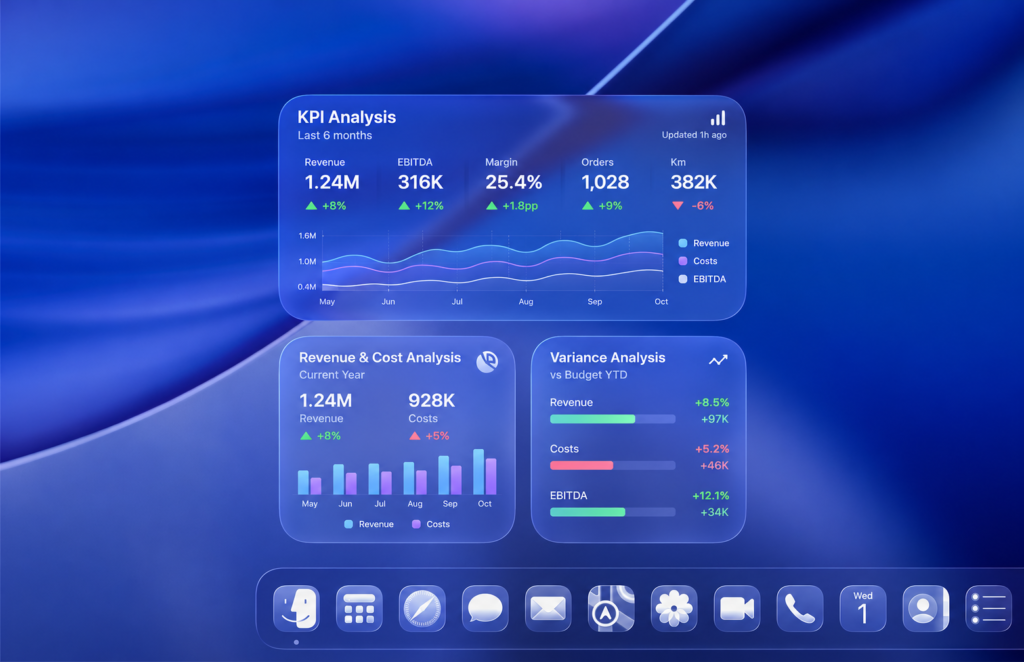
Performance Analysis.We go beyond traditional KPIs to understand what truly drives business performance. By analyzing revenues, costs, operational efficiency, and performance trends, we identify the factors behind financial results, explain variances, and uncover opportunities for improvement.
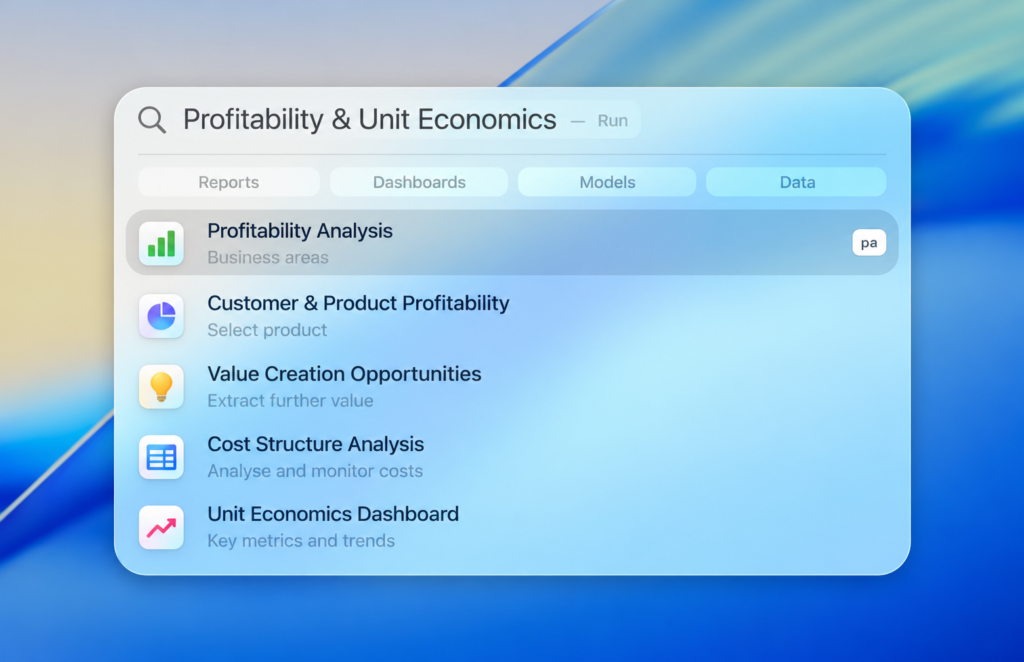
Profitability & Unit Economics. Not all revenue contributes equally to profitability. We analyze products, customers, and business activities to understand where value is generated and where margins are eroded. Through unit economics and contribution margin analysis, we identify opportunities to improve profitability and allocate resources more effectively.
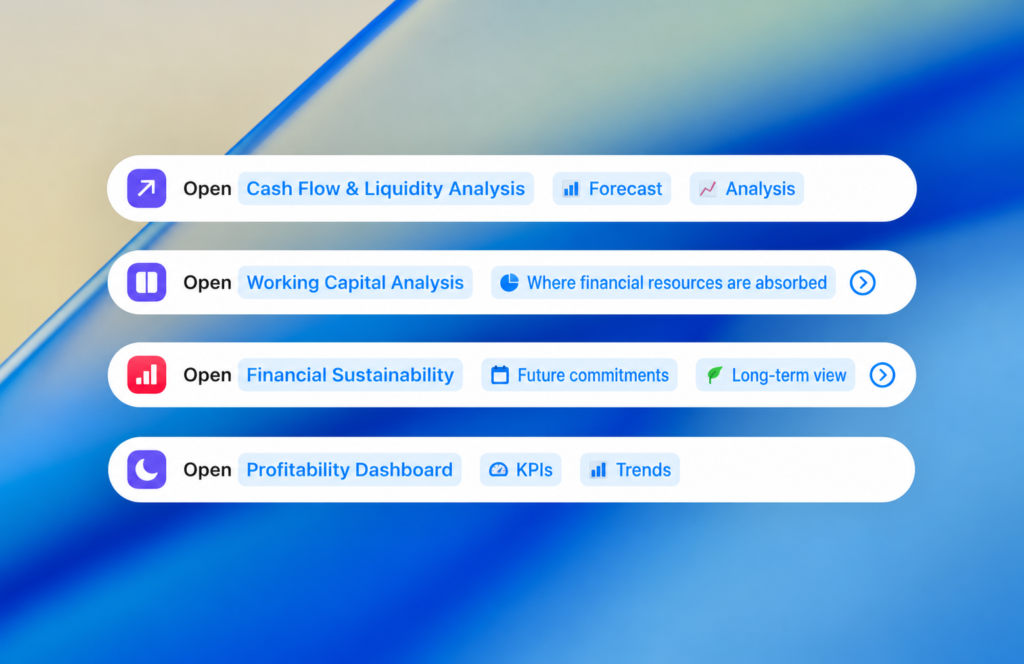
Cash Flow & Liquidity Analysis.Profitability does not always translate into liquidity. We examine cash generation, working capital dynamics, and future financial commitments to identify where resources are absorbed, anticipate liquidity needs, and assess the company’s ability to sustain its operations and growth.
Question & Answer
Good question Better decision
How can I understand what is really driving my company’s performance?
It may seem obvious, but the answer is different for every company.To understand performance, you need to look beyond financial metrics. The key lies in identifying the factors that drive a company’s competitive advantage and how that advantage translates into long-term value.For example, if product quality is a company’s main competitive strength, performance analysis should include specific KPIs that measure and monitor quality, rather than focusing exclusively on financial results.
Which products, customers, or business areas are actually generating value?
Identifying where value is created is not always straightforward. Products and business units often share costs, resources, and operational synergies, making it difficult to isolate their individual profitability and cash flows. This is where financial analysis becomes essential. By applying appropriate allocation methods and financial metrics, we can assess the contribution of each product or business area, even when financial flows cannot be perfectly separated. The objective is to understand which activities genuinely create value and which may be absorbing resources without generating adequate returns.


How can I understand what is really driving my company’s performance?
Profitability does not necessarily guarantee financial stability.Even a highly profitable company may face liquidity problems when cash inflows and outflows are not properly aligned. The first step is to understand the timing and structure of cash flows, identifying potential imbalances between incoming and outgoing payments. From there, financial analysis helps identify unnecessary cash outflows, improve resource allocation, and establish a more sustainable financial balance.Translated with DeepL.com (free version)
How can financial analytics support better business decisions?
Financial analysis helps companies understand where to focus their efforts and where corrective action is needed. By linking financial results to operational data, companies can identify opportunities for improvement, allocate resources more effectively, and make decisions based on measurable data rather than assumptions. The goal is not simply to understand past results, but to use them to make better decisions for the future.
Capital
Capital that moves
business forward
We believe capital is more than a financial resource. It’s a strategic tool for building stronger businesses. From capital structure optimization to funding decisions and strategic allocation, we help companies make every financial decision count.